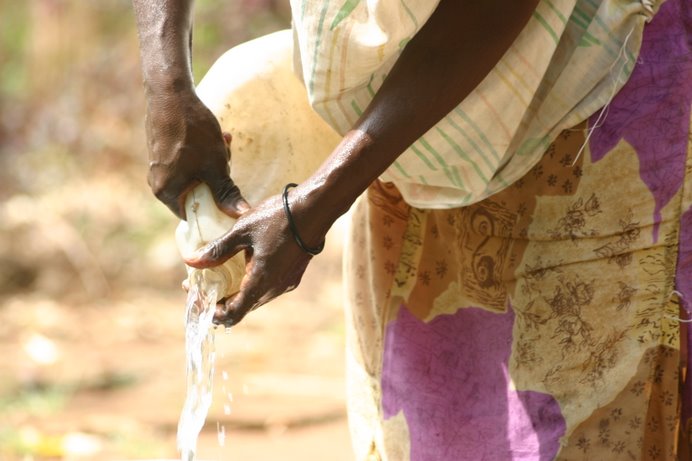
Many Kenyan women I know are very much like the Proverbs 31 Woman. They consider fields, they rise before dawn to care and prepare for their families, they save for the servant girls, give to the poor, they’re good money managers, business women…Their children call them blessed and so do their husbands. Their arms are strong for their task and so is their neck.
Life in Bible times is much more accessible to my mind and more palatable to my understanding since tasting Kenya. In Kenya, you don’t need to weasel your way into this passage and spend time thinking about how it translates into your life. A Kenyan woman often considers fields, and when it belongs to her family, she digs and digs. She prepares the shamba with rhythmic, forceful swings of the jembe. She raises it above her head and releases it down with a noise that resonates out of the ground and changes depending upon the last rain. Black cotton soil cracks in the sun and makes short, struggling chlink chlink sounds as the metal edge picks its way through. The sound of wet soil is more of a shlink, shlurp, suctioning sound. The wet soil is like a hostess who quickly and warmly welcomes you in, but then clings to you, hanging as you make your way to the door, not wanting you to leave.
Many families have house girls who are usually a younger relative like a niece or a cousin or a sister who want a change of pace from their home or need a sure meal and a place to sleep. They take girls, and often treat them like daughters in a way.
“Her husband has full confidence in her and lacks nothing of value. She brings him good, not harm, all the days of her life.” This makes me think of David and Meshack, the two fathers on the farm, and how they love and trust their wives, Anne and Susan. They adore them and respect them and are always being thoughtful towards them. The word “confidence” is the perfect word to describe their stance toward their wives. They make decisions together a lot more than other couples that I see in the area and they also like doing things together. I am delighted when I hear things like this: David says, “ Oh, let me just pull over here and buy some tomatoes for Anne, she will be so happy.” Meshack says, “You won’t mind, what I am gonna do, is to stop and pick up some bananas because my wife loves to eat bananas.”
“She sees that her trading is profitable, and her lamp does not go out at night.”
I think of Anne Isuvi measuring their milk out to people who come to her kitchen to buy. I think of Rosalyn and Juliet who have little shops in their homes where they sell the essentials: soap, Roico seasoning, little yellow balls of cooking fat wrapped in plastic, sugar, salt and matchboxes and kerosene. I see Rosalyn’s head balancing a load of firewood, which she traded by giving an old Mama some beans to plant. Her trading is profitable; she knows what her family needs and what she has to give. They trade buckets of maize for a day’s labor of weeding in the field and trade vegetables for vegetables.
“She opens her hands to the poor and extends her hands to the needy.” I see Rosalyn wrap up a hot chapatti in a torn corner of the flour sack and send it home with the lady whose house burned down last year. I see her piling mounds of popped corn, hot off the fire, into the cupped hands of the little raggedy boys sent to her to fetch their family’s milk for chai. They sit on stools and stuff the popped corn into their mouths with both hands held close to their face for easy access. Their teeth and the whites of their eyes match the popped corn and they all work in unison to fully satisfy Rosalyn’s generosity.
Sizco sits shredding greens for Anne and the next minute is helping Kimae prepare chapattis for the apprentices to bring for the potluck. Nancy is bending thoughtfully over Lucas’ math problem, explaining his confusion away. Anyone who comes to chat while you’re in the middle of something, will automatically take up the task with you and talk for a bit. Kenyan women actually do get up while it is still dark and rarely eat the bread of idleness. Susan does make garments and sell them, and the women I know watch over the affairs of their household with a care and dedication that leaves little time for the distractions of luxury.
Nehemiah families begin to have a higher propensity to honor instead of blindly expect the dedicated labor and noble character of the woman of the house. “Her children arise and call her blessed; her husband also, and he praises her: Many women do noble things, but you surpass them all. Charm is deceptive and beauty is fleeting, but a woman who fears the Lord is to be praised.”
Monday, October 25, 2010


Saturday Celebration
Saturday October 23, 2010
(A graduation party for Josphat, our children’s department head)
David, in his playfully formal manner, stands up to welcome us and give a sort of agenda for our gathering. He says something to the effect of, “I think we all know why we are here; because Josphat has invited us to celebrate with him. He has done a noble thing in graduating with high honors and we are all very proud of him. First I’ll ask for a prayer, then we will sing a song, and eat…we have plenty of food. After that we will have some speeches from various guests, and from the man of the hour. Then we shall sing again and close our evening with another matter that concerns us.”
The afternoon leading up to the gathering in the church was spent busily preparing at the Isuvi house. I sat on the cement patio peeling potatoes for two hours while all around me the boys swirled in and out with pots and firewood, cabbages, chicken feathers and armfuls of tomatoes. David pops in and offers me cooked bananas and strong tea for lunch and then darts away again, gathering helpers to slaughter Josphat’s lamb. After seeing signs of the slaughter carried past, (knives, buckets of water, buckets of blood, a skinned sheep’s tail…) I finally see Ken (our lab technician) walking over with a huge grin and a bucket with protruding hooves and carved delicacies. “I am a slaughterer!” He tells me jokingly and swirls the bucket around as I peer inside. The joyous bustle culminates as all the other woman come to the kitchen to help make chapattis. I am in awe of Josphat’s generosity and ask if we should have just done it like a potluck where everyone contributes a dish. But he says no, he wanted to bless us and have a way to thank us all. And besides we were helping in the preparation anyway. I can’t but think how much this meal will set him back, but in true Josphat fashion, he thinks more of others than he does of himself.
We are all satisfied and full of rice and meat and cabbage, licking the grease off our fingers and finishing the last of our bottled sodas. The florescent light of the church is only available because of the generator, noisily groaning with the tractor outside. The power is out but our milk needs chilling and our party needs light. Voices slide away silently and our faithful M.C. rouses our attention for the speeches. “ I am just going to call upon a few people to say something about Josphat. Fidelis, you’ve been with Josphat, what can you say to him?” Fidelis stands, smiling as always, pauses with decorum and proceeds: “Good evening, we want to thank Josphat for being with us and caring for us. We love him and we need him.” The speeches went on and on, as David randomly and surprisingly gave each person present the opportunity to affirm Josphat. Anne made jokes about him as her “first born son” in a manner worthy of a mother, Jeanie encouraged him to start looking for a wife, friends told how much Joshphat had encouraged them. The boys all thanked him, and there was not one person with any thought but joy and gladness that we know and have Josphat among us.
I can’t stop smiling and even crying for how beautiful and life giving those words are to Josphat. The openness of the Kenyan heart shines like I’ve never seen this night and we aren’t waiting for a funeral to praise a person. He also stands and gives each one of us a word of gratitude and friendship. Josphat has no supportive family apart from Nehemiah, but he fears the Lord, takes advantage of opportunity in humility, and loves people, which gives him great success. He was honored with the highest position in his psychology and social work program and received many offers from organizations, but he knows he is called here for now. This family celebration is truly the first of its kind here at Nehemiah as we have never honored and appreciated one person in this formal and intimately united of a way. The overarching sentiment is that Josphat is bearing fruit. Fruit that he has shared and blessed us with.
Songs are sung and prayers are said and one last item remains. David hands the floor over to Meshack who stands and begins with reminding us of the purpose of families. He says something like this in his melodically loud and eloquent way: “ We come to share together our joys because it concerns us, and we are happy together when one of us is rejoicing but when something bad comes, we also want to share in it because it concerns us. Tonight we want to bring to the community’s attention, something disappointing. But when one of us is gone astray, we want to bring him back because we care about him. Solomon would like to give a confession.” Solomon stands in front of us, solemn and pressed. He strains to confess over the noise of the generator, but his volume is not satisfactory. Meshack translates his volume and forms such an interrogating voice that he would be more appropriate in a court room. Solomon confesses publicly, although some of us are aware, that he snuck out of the fence and slept with a girl in another house. By doing this he has broken most of our rules, namely, sneaking out, having a relationship, and dishonoring and lying to his parents. He asks for our forgiveness. The floor is opened to various people for responses. He is forgiven but not trusted, for regaining trust takes time and is up to him. Please pray for him as he is so well loved, yet rarely repentant to the point of changing his behavior or heart in other similar cases.
The mood with which we leave the church is an entirely opposite atmosphere than the way we entered. In some ways it seems odd and inappropriate to me to have both agendas smudged into one evening for the sake of convenience and timing. Yet in another light, I see the goodness and grace of being able to hold two things in our hands at once; to pair our joys and sorrows together as any family would. The foundation of love in the first half epitomized and peaked the beauty of our community which set the tone for loving discipline, although it was not facilitated perfectly, it seems right to be capable of handling opposites in such a way that reminds us who we are as a community and how in all ways, we want to help each other grow.
Monday, July 12, 2010


Saturday, June 26, 2010
Those Good ‘Ole Luo Days
I am involved in a widows and orphans group in Ohero, off the Nairobi—Kisumu rd. One day the group got together to bead bracelets and while we beaded we storied. “Tell Anna about the olden days around here,” says my friend to Alonso, the Mzee (old man). Mzee leaned forward and stared into his bowl of beads for concentration, for composure and after a pause to rewind the years he slowly began to speak.
“Oh yes, I’ll tell her. I was born in 1939. I remember how the community members used to be together. They could sit and discuss in a forum, they talked about their welfare, or plowing; they discussed everything so at the time of harvest, no one would have to beg and everyone would have harvested. Those who had animals could herd, others would go for wrestling as recreation—the best wrestler would be chosen—then they would invite another clan to compete.
I was ten, and I saw how everyone was together. I saw how they armed themselves in defense of other clans like the kipsigis. Those clans were coming to raid. In meetings they planned how to defend from external attacks and cattle raids. They were using arrows and spears. But we Luos were not planning attacks, just defending. … It prompted the Luos to remove the lower six teeth—for identification—in a war we’ll see if you are one of us, or one of them. Also it was nice for passing medicine to someone whose mouth refused to open. The space was helpful, but now we don’t do that anymore.” I told him to open up and let me see. He smiled to reveal his toothless lower gums.

“I’m seeing differences in how we were together then, and how we are together in present. A long time ago they were loyal and faithful to each other—they were serious—the difference between the older generation and now, they’re just not serious. Now people back on their agreements and want to do things on their own. But you see here this group of ours, it isn’t so new in theory of course. Our purpose is just a little bit different from those days. Now we believe that the Government is defending everyone, so now our group has a different role. We come to share new ideas and to agree. Being in a group makes people know each other. I went to such and such a place and saw that, can we try it? Will this work? You share a lot, you find out if people are sick. When I heard he was sick, they called me, we collected money and sent him to the hospital and now look at him, he’s recovered! We see that this friend of ours is needing new thatching on her roof, you see how it leaks when the rain gets in? We arrange and build her a new roof. That’s why we have groups now. “
Now we turn to Mary, his wife, her hands deftly stringing beads as she muses over the past like sucking on a cherry pit---The tart and sour taste of those memories are gone, but something solid is left. She begins mildly, her age roughly 14 years less than her husband’s, but still a grandmotherly type—a “Danni”. “There was a method of marriage back then—eloping. When I was 13, I came to visit one of my relatives here. We went to the market to buy some vegetables. The men were sitting, and then all of a sudden they forced me to go home with them. If you refused, they cane you or carry you there. Those men were friends of my husband’s. They were sent to bring me home to Alonso because he had seen me in the market. Then they guarded the door so I wouldn’t run away. They were ready to fight my brothers who would come. Once you go into that house and become a woman, a wife, you can’t go home, so I stayed. Then the dowry was all arranged—that’s how we did it back then.” The happy old couple look at each other and that is that.
Monday, June 14, 2010
Churches and Hospitals
June 13, 2010 Sunday Morning 8am
The chapel is in the middle of our compound and through white iron shutters I can see the apprentices coming down the road that leads from the dairy. Other family members are coming late, but immaculately dressed after spending the morning hanging up a line-full of dripping fresh clothes. Nancy, my roommate, gets up to lead the service and urges us to get up and say, “Welcome to the house of the Lord” to our neighbor. She says, “ I know we all live together, but maybe you have not greeted everybody yet this morning, maybe you can just stand and ask how someone slept and just say hello.” I love the orderliness of our Sunday services, which separate the ordinary, sporadic greetings of every other morning. I love being directed to inquire after someone’s sleep, and seeing work clothes replaced with tucked trousers and pressed dresses---even though the church consists of our small Nehemiah community and only a few people from outside, it is a morning where we are all in the same place at the same time and there is a uniqueness about it that I love. It reminds me of the feeling I get when my family is all home at the same time, but what I want most is for us to just sit in a circle in the same room and just be altogether.
A few people get up to lead us in singing and the room is filled with the sound of intricate clapping and muted drumming from the buckets covered in animal skins. All songs are lead out and followed with repeating choruses by the congregation, who join in seamlessly from one song to the next. You let the leader sing, and her sound fills the whole room until it is half drowned with a crashing wave of echoing and agreeing voices. The songs are never planned, just sung. And when the songs get slower and the harmony comes stronger and the sound softer, you know the singing will cease and Nancy will say, “Just come before the Lord, pour out your heart to him, tell God who he is…” and everyone whispers his own prayers.
We all sit down and anyone who has something to share is given a chance to come forward. “If anyone has an encouragement from the word, a song, a memory verse, a testimony---we welcome you” This is one of my favorite moments in church, either lasting 5 minutes, or half the service, you never know. This particular morning is memorable to me because I realized it is a platform where the question “So what’s God doing in your life these days…” is openly communicated, showing us more of who God is and what he is doing in our midst.
Lucas: Praise God. (Amen) Praise God again. (Amen). I am thankful for God’s healing power today. On Wednesday while I was at school I became very sick, I was just lying behind the school vomiting, even blood, and I couldn’t walk home. I was feeling headache and hot and then I started to get these bumps all over my arm. When school was finished Robert told this man to give me a ride home on his bike because I was walking so slowly and painfully. I was then taken to hospital and admitted for Malaria. I just want to say that God’s plans are not the same as man’s because the doctor said I would be there for five days but after two days I was healed. I remember praying on the second night and when I woke up, I was completely fine. I am now just a bit week. I came home physically the same as normal, but spiritually, I am different. Thank you. (Amen’s dabble the benches)
Meshack and Susan: Ok praise God! (Amen) Bwana safiwe tena! (Amen). I just have a testimony with my wife Susan, the Lord is really doing something in our lives. We haven’t been here for the service for a few weeks and as you can see we are changed, Susan is looking different on the outside and we are also different inside. As you know, two weeks ago we were blessed with a baby boy. But that baby boy had a problem. His intestines were not fully inside him and the doctor gave him some surgery, but he could not handle the second surgery and he went home to be with Jesus. But I was at the hospital with a man who had to bury the wife and the child, and I am praising God that he has spared me my wife, that we will continue well in life with another chance, with more children to come. We are seeing this, our first child, as a firstfruit, that it is not the end. We are thankful for how we were supported by all of you during this time! Susan do you want to say anything? Yes, but first I want to sing a song… “We give all the glory to Jesu..” (her song was swallowed up by her hands shoving the tears back and Anne Isuvi took up the song for her and the rest of us joined in, but as soon as Susan started crying I lost it and cried too.) Then, Meshack and Susan, swaying in a side-hug, led us in “What a Friend we Have in Jesus”
What a friend we have in Jesus,
All our sins and griefs to bear!
What a privilege to carry
Everything to God in prayer!
Oh, what peace we often forfeit,
Oh, what needless pain we bear,
All because we do not carry
Everything to God in prayer!
Have we trials and temptations?
Is there trouble anywhere?
We should never be discouraged—
Take it to the Lord in prayer.
Can we find a friend so faithful,
Who will all our sorrows share?
Jesus knows our every weakness;
Take it to the Lord in prayer.
Are we weak and heavy-laden,
Cumbered with a load of care?
Precious Savior, still our refuge—
Take it to the Lord in prayer.
Do thy friends despise, forsake thee?
Take it to the Lord in prayer!
In His arms He’ll take and shield thee,
Thou wilt find a solace there.
Blessed Savior, Thou hast promised
Thou wilt all our burdens bear;
May we ever, Lord, be bringing
All to Thee in earnest prayer.
Soon in glory bright, unclouded, There will be no need for prayer—
Rapture, praise, and endless worship
Will be our sweet portion there.
Anne Isuvi: I just want the visitor to come help me sing this song. (Her sister makes faces from the pew and says, “me?” with her eyes as she reluctantly joins Anne to sing a hymn)
Kimae, Gordon, Fidelis…all get up to share verses…
Friday June 11, 4pm St. Monicah’s hospital
Josphat. Lucas, Sizco and I all sit on a hospital bed, talking, not talking, praying, waiting for Sizco to get an IV. We had come to pick up Lucas, and admit Sizco. I was struck by what an amazing thing it is to have a community like ours. Sitting there with these three in silent solidarity made me aware of the uniqueness of our “family”. Here we were, all from different tribes…Sizco’s a Nandi, Josphat’s a Luhya, Lucas is a Luo and I am…What tribe am I from anyway? I am a Washingtonian? Yet we were answering the doctor’s questions as brothers or sisters….”No she hasn’t eaten anything today…She is 22 years old…We will pay in cash….She is applying to be a nurse…She is our sister…Josphat is a pro at women’s hospital wards. Everyone in Kenyan hospitals needs a caretaker who can stay with them and help them eat or go to the bathroom holding the IV bag, or running to get the nurse etc… Josphat saw a woman in the next bed, thin as stick bug trying to pull her food closer. He went over and helped her eat, ran somewhere to find a straw, talked to her, came back…”You know she doesn’t have anybody staying with her. I spent a month with my mom in the hospital before she died, I just slept next to her and helped to take care of her, but everyone else in the room needs help too. I saw a lot of things in that month. I got used to it. People would roll out of their beds at night and nobody is around, so I pick them up, or someone’s IV is up and I run for the Sister. “
I stayed with Sizco that night and the next day and experienced something I’ve never done here or in America. All day you watch all the rest of the patients in the room. You get to know them, even if you aren’t talking, you get to know their caretaker of a sister or daughter just by looking at each other for long enough. Various mama’s or sons would come in and out bringing tea or fruits for their old old mother acting like babies in a grown up crib. All the patients are at various stages of recovery, some walking around as if they’d been living there for weeks, but didn’t need to be there anymore, others with catheters and constant sickly sleep. Even at this nice, clean hospital, it is all open air hallways and walking outside to the toilets, and at any given time there were 4 small cats in the room, crawling under the beds and lollygagging about the wards. I didn’t bring anything because I didn’t know I was staying over, and I could hear the other ladies in the room discussing it in their kind way. Then they gave me one of their wraps and a sheet so I wouldn’t be cold. “Si baridi” I am not cold, I said. “Utaenda baridi asabuhi!” You will be cold in the morning they said. While I was sleeping one of the patients got up and put another scarf of hers over my bare feet! I couldn’t believe this kind of environment! Everyone is looking out for each other, even the patients were looking out for me, and I wasn’t even sick! Night life in a hospital is an interesting thing…being a caretaker too. It was fun getting to know the doctors and nurses and mostly precious spending time with Sizco.
Monday, May 10, 2010

April
Every morning around 8:30 (a half hour early) a troop of children come up to the library for our little class. I can hear them coming from half way down the farm as they run and yell excitedly past the other houses and through the field. Four of them are siblings and one is an only child. They immediately start singing as we gather and their little distractible bodies float in and out of song and speech and anticipation to enter the library and hear the story of Jonah one more time. Every day they ask to hear the story about Jonah and how he did not go to Nineveh at first and how the big waves came on that boat and how he prayed inside that big fish…”Jonah pray in fish kubwa!” It is their favorite story, and for some reason we have several story book versions with different pictures inside. (American Christian publishing companies have gone wacko with some of the drawings, the varieties are endless, it is amazing they can still follow the story with Jonah looking like 5 different people from a fat white old man to a young dark and ruddy fellow…) Their enthusiasm for one story over and over is endearing and makes me laugh every day. We are working on the cardinality of numbers---that counting has a one to one correspondence and the last number you say really indicates the whole amount in the set. Because they age from 2—8 in age, it is fun to see the different development stages. Letters are a big deal. We are learning how those letters represent things when you put them together. It is hilarious engaging them in this when English is their third language and they don’t speak it all that well if at all, because they will recognize a picture and say “Yes, Yes! A for ndege! (Ndege is airplane and bird in Swahili) Pictures are quite confusing you know, H for hen easily can be H for chicken and then the correspondence isn’t strong. Using their names has proved powerful in noticing letters and comparing and observing---“Wow, look, David has a big D in the beginning of his name and a small d at the end of his name…they look different but they sound the same don’t they?” The tri-lingual school system here is quite impressive. Even though they all grow beans and have seen them in the shamba their whole lives, they still race to measure our beans we planted and can’t believe how tall they’ve grown, after studying insects they can’t wait to point out all of them even if they’ve past them by in the past--Maybe they are seeing ordinary things with new eyes, which is my hope for them. Investing in the smallest of children can seem so relatively insignificant on a daily level, but is so eternally crucial.

Subscribe to:
Posts (Atom)