Monday, May 10, 2010


April
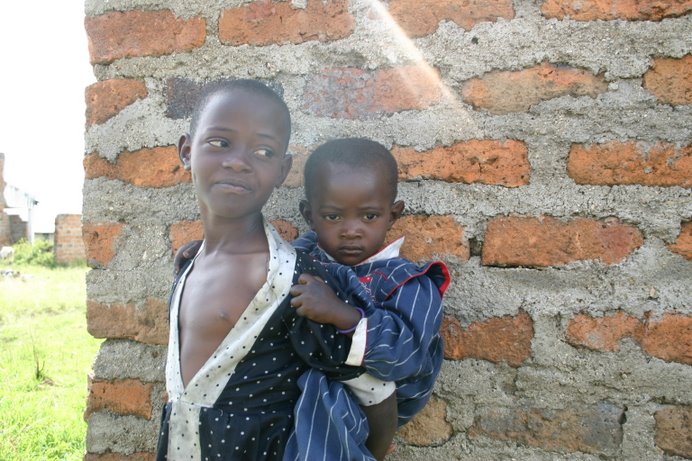
Every morning around 8:30 (a half hour early) a troop of children come up to the library for our little class. I can hear them coming from half way down the farm as they run and yell excitedly past the other houses and through the field. Four of them are siblings and one is an only child. They immediately start singing as we gather and their little distractible bodies float in and out of song and speech and anticipation to enter the library and hear the story of Jonah one more time. Every day they ask to hear the story about Jonah and how he did not go to Nineveh at first and how the big waves came on that boat and how he prayed inside that big fish…”Jonah pray in fish kubwa!” It is their favorite story, and for some reason we have several story book versions with different pictures inside. (American Christian publishing companies have gone wacko with some of the drawings, the varieties are endless, it is amazing they can still follow the story with Jonah looking like 5 different people from a fat white old man to a young dark and ruddy fellow…) Their enthusiasm for one story over and over is endearing and makes me laugh every day. We are working on the cardinality of numbers---that counting has a one to one correspondence and the last number you say really indicates the whole amount in the set. Because they age from 2—8 in age, it is fun to see the different development stages. Letters are a big deal. We are learning how those letters represent things when you put them together. It is hilarious engaging them in this when English is their third language and they don’t speak it all that well if at all, because they will recognize a picture and say “Yes, Yes! A for ndege! (Ndege is airplane and bird in Swahili) Pictures are quite confusing you know, H for hen easily can be H for chicken and then the correspondence isn’t strong. Using their names has proved powerful in noticing letters and comparing and observing---“Wow, look, David has a big D in the beginning of his name and a small d at the end of his name…they look different but they sound the same don’t they?” The tri-lingual school system here is quite impressive. Even though they all grow beans and have seen them in the shamba their whole lives, they still race to measure our beans we planted and can’t believe how tall they’ve grown, after studying insects they can’t wait to point out all of them even if they’ve past them by in the past--Maybe they are seeing ordinary things with new eyes, which is my hope for them. Investing in the smallest of children can seem so relatively insignificant on a daily level, but is so eternally crucial.

Wednesday, April 14, 2010
Story Telling
One of my favorite authors, Annie Dillard, writes, “The thing is to stalk your calling in a certain skilled and supple way, to locate the most tender spot and plug into that pulse. This is yielding, not fighting. A weasel doesn’t “attack” anything; a weasel lives as he is meant to, yielding at every moment to the perfect freedom of single necessity. I think it would be well, and proper, and obedient and pure to grasp your one necessity and not let it go, to dangle from it limp wherever it takes you…”
The tender, live spot for me is in a person’s story, in writing it and witnessing it in every way. I found out that Nehemiah really needed someone to record life here, to capture Nehemiah through the mosaic pieces of each person’s story, which come together to portray Nehemiah—a place trying to be so many things at once, a place so hard to describe without the people who put flesh on the bones.
I recently went to Kolanya to visit the Mboya family, who used to live on the farm. They are an example of Nehemiah’s goal to have our community members move on to start their own small farms, to share their knowledge and become lights and leaders in their communities. I learned so much about their lives that I didn’t know before, and I was able to witness and record how God has changed their lives through Nehemiah. It was wonderful to get a feel for their new life, the challenges they are facing in their new community and with their farm and the progress as well. I have included bits and pieces of their story below. E-mail me if you want the whole thing (it is to0 long to put here).
Basically, Tom and Rosalyn come from really hard backgrounds, they didn’t go to school, Tom was a drunk who misused his family terribly and Rosalyn was calloused and cold. A pastor befriended them and they began to change their lives and follow Jesus. They ended up at Nehemiah….
The transformation from that moment to the present is so overwhelming that Nehemiah’s story cannot be complete without the testimony of how God fulfilled the vision of Nehemiah International in the Mboya family ---the vision to help people grow and to rebuild a generation after God’s own heart. His mother doesn’t recognize him for he is a new man, those who knew them remember their bitterness, and harsh life and thought them the most unexpected couple to turn out so faithfully full.
Fatherhood
Tom
Everyday that I was there little pieces of their life slipped out and found a new place to connect to what they told the day before. One evening, after supper, Brian sat studying with a kerosene lantern while Rosalyn, Benson and Tom finished a hearty laugh over a funny snippet on NTV—national television—broadcasted on their black and white TV hooked with jumper cables to a car battery. The screen fuzzed out and Tom stood up to adjust it and then changed his mind and turned it off. Their laughs together and playful comments to each other reinforced what Tom remembered next. “I ended up with Lucas, Solomon, Isaac and Martin. It was so hard at first and they were fighting all the time. They were not from the same tribe and they were being so bad! I knew I had to make them work it out, otherwise I would have failed to be a good father and this was my task and I couldn’t send them away. You know, we started having parent training at Nehemiah so we would know how to parent orphans, but that is the time I learned to be a father to my own children also. They are no different. I was just so careful to follow all the advice, to take to heart all that we were learning. We didn’t take short cuts, and in persevering, we were greatly rewarded. “
Their family became quite close. “I can’t believe I was able to be a good father—They just came running into the house calling “Mommy! Daddy!” I don’t think any other family had that happen. I couldn’t believe that we made it! I don’t see mistakes as a bad thing, that is just learning, but to repeat a mistake is very bad indeed.”
One example of Tom’s seriousness in being a dedicated father is his learning English because his boys needed to learn it and he wanted to be able to learn with them and help them. Over the years Tom and Rosalyn both became fluent in English and now his new neighbors say he is just lying when he tells them they only went to class 3. “They are just seeing me as a University man!”
Motherhood
Rosalyn
In the evening Brian and Benson lay on the bed in the dark kitchen watching their Mom stir sufrias of ugali or beans----all food from their own shamba! The boys tut tut all the little chicks under the bed and the chickens and proud rooster daintily step over the threshold and make their way to a huddle in their make-shift roost. Benson loves to sing and Brian loves to boast so they make a little game of out-singing each other. Benson starts a song and Brian begins another and continuously begins new ones while Benson fumbles in his brain for a different song. “Ahhh! See, I can think of more songs than you!” teases Brian. The confusion, loudness and friendly banter of the boys may have irritated any mother, but not Rosalyn. Today she is smiling at them and urging Benson on. “Louder Benson, use your voice!” She encourages.
Their new home…
Kolanya is a small Teso area in the Western Province of Kenya, close to the border of Uganda. From Kisumu it takes about 3 hours to get to Bungoma by matatu . Matatus vary in luxury and maximum capacity regardless of their outward monotony. It all depends on the passengers and their wares and destinations. If the gentleman sweating in a black suit and tie wishes to alight with his large suitcase from the rear seats, perhaps the mother with the decorated little baby sucking a lollipop will half stand half sit on the lap of the old Mama next to her to let him pass. The old Mama doesn’t notice much, but looks out the window in cramped familiarity. The wooden slatted seat put in to the opening is removed along with which ever unfortunate passenger sat there and the man will now pass out the sliding door with a bit of a tumble to the roads edge. The conductor hangs on in the open doorway and clinks a coin on the roof to say, “Hit the road!” and the matatu moves on. Once in Bungoma, a fairly large city, it takes about 15 minutes on another matutu to arrive at Kimaete. The fastest piki piki (motorcycle taxi) from Kimaete will arrive in Kolanya about 45 minutes as well as many markets, potholes and puddles later.
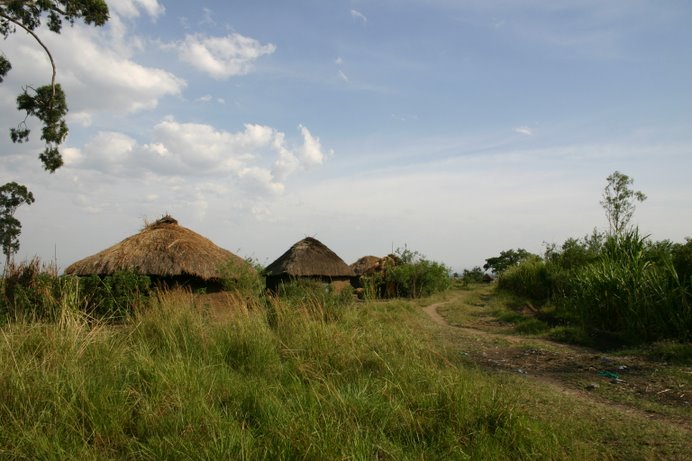
Kolanya nestles little houses between wide fields of bright, broad tobacco leaves and tall slender maize stalks with beans growing at their bases. (Maize and beans “Guidere” mixture is a common Kenyan dish. Amazingly the two foods spend their whole lives together side by side!) Tom and Rosalyn’s home is about two kilometers away from the little main hub that dabbles either side of a ten foot wide dirt road containing a large primary school, and little “dukas”—kiosks selling the necessary sugar, oil, kerosene, soap and whatever else one needs. The pathways around the area are lined with tall trees that Mzee Johnston plants. Neighbors greet each other in Teso, which Tom is picking up here and there.
The Mboya’s are Luo and are still learning many things about the Teso culture. “The problem here is that people don’t believe in God, they just believe in alcohol. Everyone is drinking so much changa (illegal maize liquor)—even the women. They even give their babies when they are first born—their first taste at their birth celebration. They are just raising very nice drunkards! But it is good they see me—I don’t drink and they see I don’t have the problems they have anymore. They see my wife and I have so much peace in our marriage and they are asking me why and how they can have peace with their wives also. I tell them it is very simple, we don’t drink and we love each other. We talk now instead of fight, because if you fight, you still haven’t solved anything. We are trying to be a light here. The view of women here is terrible. They pay so many cows for the dowry that they just say, ‘I’ve paid so much for you, now you can work!’ “ Rosalyn chimed in from the kitchen “slaves!” Tom continued, “They have a backwards view. The men just sit in the market and drink and the women work very hard. If you have a lot of daughters in Teso land, you are seen as a very wealthy family because you can sell them for a very nice dowry.”
Despite the general drinking culture, the Mboya’s neighbors and daily lives seem blessed with friendly neighbors who drop by to buy milk, provided by the Mboya’s cow “Gift”, or to trade vegetables. Even the boys, Brian and Benson, light up the community and host little football gatherings in the yard after school as well as raise rabbits to trade for chickens with the neighbors.
Future Hopes and Prayer Requests
They would love to keep orphans again and to continue blessing others as they have been blessed. They are not concerned about the food, but they want anyone who stayed with them to go to school and are not able to afford school fees at this time. Pray for a way for them to set a radical example in their community and be able to be a father to the fatherless and a mother to the motherless. Pray for wisdom in their farming and for innovative ideas to scale up their farm, take risks and find a steady market. Pray for the continuing safety of their cow, who has been fed hidden metal objects wrapped in leaves by jealous neighbors. Pray for deep friendships and trustworthy people to share life with. Pray for their continual protection against sickness, especially Malaria, which they have experienced frequently since the move.

Final Thoughts
Tom: “We learned so much from Nehemiah, I remember everything that Jeanie has taught us and everyone else. I remember especially the time she told us that people have hard stones around their hearts and that ministering to people means to remove those stones one at a time. That was me. I had so much hardness in my heart, but now it is gone. I realized that it is a sin not to value yourself and to have low self esteem. I lost so many years thinking I was a nobody, but God knew I was a somebody. I can’t believe what he’s done for me.”
__________________________________________
The Grandmother and the Egg (a silly story for Heather…)
There is a grandmother here whose chickens lay one egg a day. She has so many grandchildren she doesn’t know who to give the egg to. She also really likes to eat eggs herself, so she tells the children that the doctor prescribed her one egg a day to be eaten with her eyes closed to keep her in good health. I asked why she had to close her eyes—she closes her eyes so that she doesn’t have to look at all the sad children’s eyes watching her eat the egg! Clever huh?
Speaking of eggs…
I have been teaching a small class of little children from 2 years to 9 years. However, they all have lots to learn and love everything we do (even learning to recognize and write letters is wildly exciting to them—I wish I could remember what it was like not to remember which was which!) Back to eggs…We dyed some hardboiled eggs to learn about what happens when you mix certain colors together. That was all well and good, but the real joy was when they discovered we were going to eat them! I loved watching them glory in the taste. Eggs are my favorite food so of course I was just as happy to be eating an egg with them and hearing them sing the little song we made “E double G spells egg!” We read story books and Bible stories and learn about how the world that we live in works, what it takes for seeds to grow, why the rain comes, how to count all the fingers in the whole circle (whew!) They also lead in songs---Yes, even Terry, the three year old, is as bold a leader as any Kenyan Mama leading a service.
Other fun happenings…
- · I have been making homemade yoghurt from our delicious milk. You should all try it, it is soooooo easy!
- · I also made homemade gingerale, which becomes bubbly by putting a bit of liquid from the yoghurt or whey in your mixture and letting it sit at room temp for a few days. It is delish.
- · I know how to milk cows now
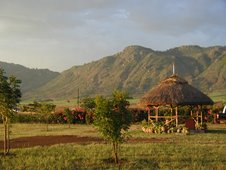
- · The weaver birds have moved to the thorn trees by the pond (see pic at top of blog)
- · I got to go on a bike ride with my friend Josphat on Sunday afternoon to visit one of our boys, Martin, who went home to be with his Grandmother for a while. We rode on the classic Kenyan archaic and heavy contraptions that take work just to hold them steady. It was so fun to ride all over through the villages of Kano and Obumba and visit other friends as well.
- · I am continually impressed by our apprenticeship meetings---I’ll write more about them another time…
- · The students in Form school are back on the farm for the month of April, so the farm is fuller and more lively at the moment.
- · My dad sends weekly updates about what’s going on at home to all his girls who are away from him. I love hearing your news, thanks to those who have e-mailed, I love hearing from you and will try to be more prompt in writing in you back!
- · On Sunday Paul, one of our boys in 9th grade, was welcoming people to the front pews of the church but nobody moved. He told the whole back bench to switch to the empty front bench, to encourage them he said, “I think when Jesus comes we will all just want to be sitting in the front row, so why don’t you just come now?” It was really funny.
- · Last night I taught Nancy how to say, “Goodnight, sleep tight, don’t let the bed bugs bite”—(I told her bugs are insects). “How do you say it?” she asked, “Goodnight, sleep well, don’t let insects bounce off your beds?” Then I realized it is a silly (but extra appropriate) thing to say, but it is so catchy I can’t stop!
Saturday, April 10, 2010


Tuesday, March 30, 2010


Monday, March 15, 2010
March is going by so fast!

February 26 A small picture of something very big…
Today Nancy came into my room and decorated the walls with tissue paper streamers she cut and posters. I had been so excited about having my own 6x6 space to keep however I wanted—a haven. I had been enjoying the simplicity and beauty of staring at flowers in an old water bottle on a stool and the blank wall. What a picture of classic cultural exchanges that occur in the other direction so often. I am most cautious about imposing ideas I think are wonderful if they are not initiating them or invested. Now it is my turn to feel the consequences of an imposed idea. I see how easily they can just keep quiet to please you, and then abandon the idea as soon as you leave. I feel the same way--how can I take these decorations down when she has so thoughtfully invested her love, time and resources to bless me? Yet if she leaves I would abandon these decorations the same day.
February 28 No, I am not a cannibal…
Baada ya mkutano wa kwanza, nita enda mkutano wa pili. On and on I struggled with their assignment of detailing what I would do that day. In the end I managed to say all that I would do. We threshed maize which I’d never done before. We whacked the dry maize ears with a fat stick and made the kernels fly everywhere around the small cement room—down my shirt, in our hair, up the walls. Then we sat for hours and days prying the kernels free with our fingers. It works best to slide the rows sideways but if they are large and dry you can twist your hands around the whole ear and they will easily fall. During these hours we make three part harmonies in which the base and soprano always fail laughing and the alto always wins. We also talk and on this occasion I said, for the third time this week some sort of innuendo in Swahili that I was a cannibal. It all started while we were slashing in the orchard. Sizco told me how she first came to Nehemiah in Form One. She was afraid to come because she had heard that Mzungus ate other people. We fell down laughing at this and she recalled how another girl was about to come with her, but chickened out at the last minute. “It was just the Lord that brought me and I am so thankful now, and see how funny it is.” The next day while relating what I would do during the day I said, “Baada nitakupika” which means “Later I will cook you” (I used the infinitive instead of nitapika –I will cook. I didn’t think I said anything wrong but because of our earlier conversation Sizco could not stop laughing! Later, I honestly mistook the word “girl” for the word “lunch” while translating from a book. “Sizco, Msichana means lunch doesn’t it?”
March 7 The best welcome
I went to Kano today to see Milka and her family. I went alone, and felt so free with no one in sight and the wide expanse before me and behind me. I waded through knee high streams and drenched grasses and kept my shoes off through the rest of the thick mud. Claudia always says.. “Matope ni nyingi” Now I know how to say “There is so much mud!” I passed several houses of plastered smooth mud with iron sheets or thatched grass. I know many of these families vaguely but I was on a mission to find Milka’s house. I headed in the direction of Kao School, past the railroad tracks, past the river flowing with chocolate milk and Rooibos tea, and past the newly expanded school buildings. I greeted people as best I could along the way and eventually heard Milka shouting “Anna! Anna! from beyond an irrigation ditch and a row of banana trees.
I was so excited I misjudged the depth of the ditch and figuring it was about knee high, I plunged in. To my surprise I fell in to my hips and was pulled out, laughing hysterically, and surrounded by Milka’s intense embrace and the rest of the family (Grandchildren, sons, daughter in laws…) who welcomed me like no other welcome in my life. I noticed a round-bellied cabbage patch girl standing naked in the gathering who was immediately whisked away into an oversized yellow frilly dress that dragged behind her like a proper princess gown, snagging on thorns and becoming less yellow every minute. She was brought back and introduced to me as Anna Schuler (Shoolay)—my three year old namesake! She smiles all the time and has a magnificent rounded overbite, that, combined with her all around brown round pleasantness, reminded me of Mrs. Beaver from Narnia. She followed me around most of the afternoon and we became good friends. Even when the mzee would wave his tired hand to shoo the other children out of the house, she would stay as they scattered.
When I first entered, Milka excitedly presented me to her 8 sisters and cousins who were squished together on the wooden couches. We came clapping and dancing and they all joined to slap my hands and kiss my cheeks. “Ide Nade?”---“Adi maber!” ----“Eh! Oyoure?”----“Oyoure a enya” I passed along the Luo greetings but that is all I know. Everyone is so encouraging about languages. They make you think that if you surprise them with casually saying Good Morning in mother tongue with no trouble that you will be fluent in no time. I think it takes a lot longer.
They were all gathered to have their monthly merry-go-round, which is a loan sharing money pool where you contribute to one person each time. They sat there in their pretty dresses and head -scarves for awhile, then they got ready to go. The ladies helped one sister assemble her wig—She finger combed it before, then they helped her by being the mirror. Then they smoothed it with body lotion till it was sleek and black. They each pool 200 shillings, which is less than $3 but adds up when everyone contributes.
Later, when they returned, they agreed at my plea for them to sing. Sisters always know how to sing together—even if they are silly songs. I had no idea what that would turn into. It starts like rain—one drop—one voice thinking of a song out loud—quiet, timid and affirmed by another voce and then the first livens up the lead and you can hear it now coming in a throng and then the claps begin just like the thunder claps and then mmm mmm we’re all on our feet and since I don’t know any of the words I start to move a little and they love it and start moving too. But the roof is too low and the mud walls to confining and the low wooden table is hitting our knees so she leads us outside to the rhythm of the claps and the 50 or 60 year old sister lady club and I duck under the doorway and circle in the sunshine. I can tell they are loving it just as much as me—I always knew dancing was the way to people’s hearts around here. The leader still leads and the rest sing a repeating phrase. I have no idea what it was about but the booties were flying and the waists were bent and the bare feet kept time in the moving circle. I suppose the rain and thunder dance storm is now in tornado phase. They kept laughing at each other and the rest of the family just sat under the eaves and watched. Lilililililil’s and Lylylylylyly’s throttle the tongues in high trills and when it was over they piled firewood on their heads and went back to their husband’s houses.
Kano is a place of intensity—happy and flamboyant as well as intensely remote with terrible hygiene and sanitation practices, intense poverty and hospitality. A few days later I returned and spent the night and came down with a high fever. It was quite an experience being so vulnerable and open with letting other people take care of you when you are way beyond self- sufficiency. At first I was praying it would just go away and when it hit harder than ever I was annoyed. Then I came to realize that maybe God wanted to use them to be his “hands and feet” and to have us experience the joy of their own ability to love and care and see their prayers answered.
March 12 George
I never think about death as much as I do in Kenya. Partly because people are constantly going around praising God because they are so happy to be alive this day, and partly because death is prevalent, public, common, practiced over and over again. It is at the tip of the tongue. In a way the frequency eases the pain. “It is just Ok, everybody dies, it is a part of life!” she says the week before her husband dies. There is a hand written poster entitled “Time Wasters” in the Miwani Estates teacher’s lounge. Item # 1 long meetings, item #2 long tea breaks, item # 10 weather conditions, item #12 sickness/death.
I just returned from our dear friend George Ogola’s transitional funeral. They were transporting his body from the mortuary, to his house for a “practice funeral” and on to his mother’s property for the proper funeral and burial. He was one of the original farm fathers who used to have Shebby and Robert and Dominic and Bonface living with him. He and his wife Juliet have two daughters, Jeanie and Claire. They are almost 5 and 3. It is hard to even fathom.
The herse came in the form of a big black bus---dull, matted and chalky black, not shiny limo black. We could hear the referee whistles blowing and the wailing and singing coming down the rocky, red road to the house from a far distance. The procession from the mortuary was awaited by a few teachers and family friends who stayed behind to prepare chai and bread and guidere—a maize and bean mixture. I was luckily friends with the ones preparing and was soon put to work serving the refreshment. The mother, step mother, solemn Juliet, frilly Jeanie and Claire and all the rest stepped out of the bus. The men opened a compartment under the bus and pulled out a shiny wood coffin and carried it inside. One by one the wailing women old and young passed through the yard and into the house yelling “George, Moyo oh mOyo! La la!” and tossing there hands in a grief as old as their traditions and as new and fresh as their genuine loss. However, sometimes it is hard for me to tell the difference. I am the only one trying to distinguish between them and I suppose I don’t need to.
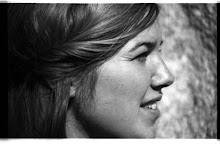
The whole procession was video taped. Everyone gathered around the open casket with only a glass separating the altered George who is no longer George. He was already home. We sang and prayed and the men sat under a tent for shade and the women went inside to sing hymns led by Juliet. I knew all the hymns by their tunes, not by their kijaLuo lyrics. I listened to them as I cut bread outside. (The picture is of Jeanie)
Thursday, March 4, 2010


Subscribe to:
Posts (Atom)